
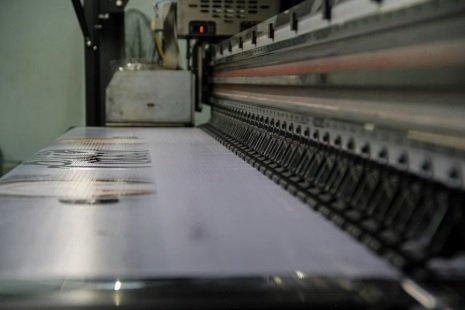
Need to shave hours off production time? Are you tired of sinking money into antiquated printing processes?
Industrial inkjet printing workflows have revolutionized commercial printing. Take packaging systems, labelling machinery — you name it.
On the other hand…
Businesses are stuck with inefficient, fragmented workflows that cost them time and money every day.
Outline
- Why Industrial Inkjet Wins The Day
- Identifying Workflow Bottlenecks
- Top Tips To Optimize Your Workflow
- How To Choose The Right Setup For Your Business
- FAQs
Why Industrial Inkjet Wins The Day
Let’s look at the numbers.
The industrial inkjet printers market hit $6.5 billion USD in 2024 and is expected to grow at a CAGR of 6% through 2034. From packaging companies to textile manufacturers and everywhere in between, everyone is jumping on the bandwagon for a reason.
In order to understand why industrial inkjet printers have become such a powerful tool for businesses we must look at their core value. They print onto virtually any substrate at high speeds without the need to switch out plates or perform any setup. No waste.
Efficiency.
Fast printing speeds, low waste, and incredible versatility make industrial inkjet ideal for just about any business that does variable data printing.
Here are the benefits of industrial inkjet technology that are driving its popularity:
- High resolution printing at full production speeds
- Print variable data (barcodes, serial numbers, expiration dates) without stopping the printing process
- Compatibility with both rigid and flexible substrates
- Dramatically less ink waste when compared to analogue printing methods
- Low TCO over time
Identifying Workflow Bottlenecks
You can’t fix what you don’t know is broken.
A bottleneck is any part of your workflow that causes a slowdown in production. This could be as simple as a slow RIP or it could be something more complex like bad file management. Perhaps your substrates are inconsistently fed through the printer or your inks require too much maintenance.
Some of the most common bottlenecks include:
- Pre-press file processing
- Poor color consistency causing reprinting
- Manual substrate handling
- Ink maintenance
- Software not communicating between departments
The easiest way to identify bottlenecks is to map out your workflow. Then, time how long it takes to complete each step. The step that takes the longest is your bottleneck.
Top Tips To Optimize Your Workflow
Alright, now that you know where you need to improve. How do you fix it?
Here are the quickest ways to improve each bottleneck:
Automate Pre-Press
Don’t waste time preparing files. Buy software that does it for you.
Software that automates pre-press will color correct, nest your jobs, and send them right to the print queue. No more waiting for jobs to be prepared.
Create Standard Color Profiles
Bad color consistency is one of the leading causes of expensive reprinting. Guess who has the most consistent color quality? People who standardize their ICC profiles between every device they use.
Make sure you are using standardized color profiles everywhere.
Connect Your Software
Are your designers working in software that doesn’t communicate with your printers? Stop it.
Implementing a print MIS will connect your sales team all the way down to the printers themselves. You will be able to:
- Schedule jobs automatically based on availability
- Track substrate and ink usage
- Catch quality issues before they ruin a job
- Get accurate job costing
Having access to that type of visibility will change the game for your business.
Use Predictive Maintenance
Say goodbye to downtime.
Once your inkjets are up and running you don’t want them to stop. That’s why many industrial inkjet businesses utilize predictive maintenance.
With predictive maintenance your machines are constantly analyzing printhead performance as well as ink viscosity, pressure, and more. If one of these readings goes below or above your set parameters the system flags it before it stops working.
The global inkjet printing market is growing at a CAGR of 6.8% — if you want to beat the competition, stay one step ahead of downtime.
Perfect Your Substrate Handling
I’m sure you didn’t think substrate feeding would be a bottleneck, but it is.
If your substrates are not consistently fed through the printer it can cause registration issues. Not to mention waste.
Automated roll-to-roll and sheet-fed handling systems ensure your substrates are being fed through at a consistent speed. You’ll save time and money by having less human interaction.
How To Choose The Right Setup For Your Business
There is no shortcut to this section. You have to ask yourself a few questions.
Different substrates, print volumes, and variable data needs require unique setups. A beverage company that needs to print expiration dates on their bottles won’t need the same setup as someone printing variable data on fabric rolls.
Here is what you need to consider:
- What is the substrate? Rigid, flexible, textiles, 3D objects?
- What is the daily volume and required speed?
- What variable data do you need printed? Barcodes? Serialization?
- What ink are you compatible with? UV? Aqueous? Solvent? Latex?
- What software do you need it to integrate with? Are you using any special production line software?
Ask yourself these questions and you will easily be able to eliminate setups that don’t apply to your business.
That’s A Wrap!
Industrial inkjet technology has become one of the most useful tools businesses have access to. But that doesn’t mean you should solely focus on buying the right printer.
The biggest wins will come from optimizing your workflow to suit that new technology. Map out your workflow, find the bottlenecks, and use this list to start improving each one.
Here’s a quick recap:
- Mapping workflows to identify bottlenecks
- Automating pre-press work
- Creating standardized color profiles
- Integrating your software with a print MIS solution
- Using predictive maintenance software
- Ensuring your substrate feeding is consistent
Keep these tips in mind and you’ll see your production throughput go up in no time.
FAQs
A1. Industrial inkjet printing is similar to the desktop inkjet printers we all know. Instead of printing onto paper at home though, these industrial machines print onto a variety of substrates at very high speeds. This allows you to do variable data printing, coding, and marking quickly and efficiently.
A2. Everyone from package printing companies to clothing manufacturers use industrial inkjet printers. Any industry that requires printing at high speeds with variable data will benefit from industrial inkjet technology.
A3. It puts you in control. If there are bottlenecks in your workflow that cause you to wait on printing jobs then you’re losing money. Use these workflow optimization tips to help you reduce or eliminate those bottlenecks.
A4. Continuous inkjet printers spray a steady stream of ink droplets. They’re used primarily for high-speed coding applications that are found on moving production lines. Drop on demand printers however only spray an ink droplet when it is commanded to do so by the printer. This allows for higher resolution printing.
Also Read: From Application to Offer: How Technology Is Reshaping the Hiring Timeline

